


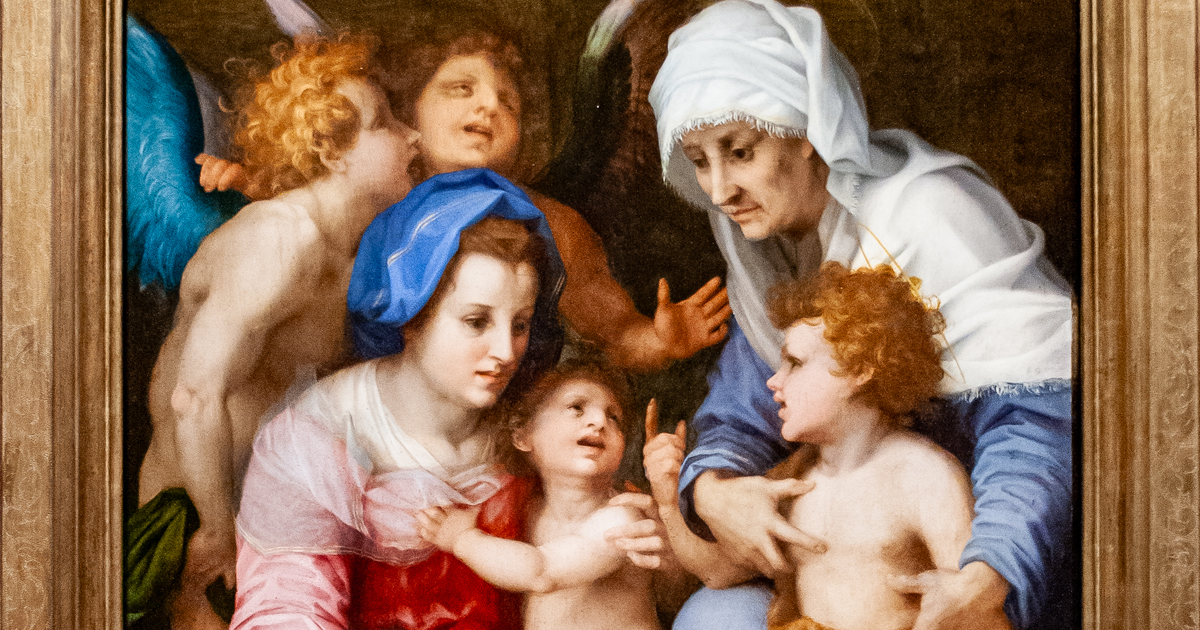
The Holy Family — Andrea del Sarto
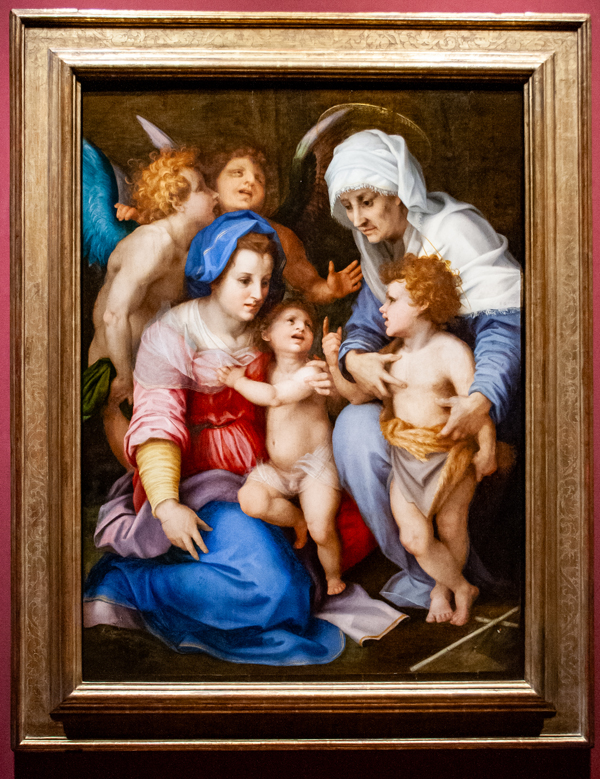
Title: The Holy Family (La Sainte Famille)
Artist: Andrea del Sarto (1486–1530)
Country: Italy
Year: c. 1515–1520
Medium: Oil on panel
Dimensions: 145 Г— 110 cm
Location: Louvre Museum, Denon Wing, Room 708
Category: Religious composition
Style / school: High Renaissance, Florentine school
Context of creation
Andrea del Sarto, one of the most subtle painters of the Florentine school, created this composition at the boundary of two eras — when the ideals of the High Renaissance had not yet lost their force, yet the drama of Mannerism was already emerging. The painting was likely made for a private chapel or a wealthy patron. It demonstrates not only the artist’s mastery, but also his inner attentiveness to stillness, light, and tenderness.
Subject and composition
The painting depicts five figures, brought together in a calm, balanced composition. At the centre is the Virgin Mary, holding the infant Jesus on her lap. On the right is Saint Joseph, attentive and restrained. On the left is the young John the Baptist with a cross in his hands. Nearby are two angels, gently observing the scene. The figures are bathed in soft light, united by gestures, glances, and the movement of hands. It is a moment of love, calm, and the foretelling of a great destiny.
Style and technique
Andrea del Sarto was a master of sfumato and harmonious colour. His palette is quiet and soft, without harsh contrasts. A distinctive feature is the perfect transitions between volume and background, remarkably lifelike fabrics and faces, close attention to anatomy and expression. His art is refined simplicity, where beauty does not shout, but breathes.
Fate of the painting
The painting appeared in France in the 17th century as part of the collection of the Barberini family. It was later transferred to the Louvre, where it received its own display niche among Florentine masterpieces. Its influence can be traced in numerous copies and engravings, including in 18th-century French art.
Personal view
This scene is like a prayer without words. No drama, no excess — only the inner movement of love between mother, child, father, prophet, and angels. It seems time has stopped here, so that we can have time to feel the stillness. Everything in the painting leads not to the mind, but to the heart.


