


Portrait of a Man — Titian
Title: Portrait of a Man, known as “Man with a Glove” (Man with a Glove
/ L’Homme au gant)
Artist: Titian (Tiziano Vecellio) (1488–1576)
Country: Italy (Venetian school)
Year: c. 1520
Medium: oil on canvas
Dimensions: 100 Г— 89 cm
Location: Louvre Museum, Denon Wing, Room 711 (Salle des Г‰tats)
Category: Portrait
Style / school: Italian High Renaissance (Venetian portraiture)
Context of creation
This portrait was created by Titian at a time when he had elevated the art of portraiture to a new level. Around 1520 the artist already enjoyed a strong reputation and worked with influential patrons. The canvas was likely commissioned by a wealthy Italian family or a court circle, reflecting an aspiration to present the sitter’s individuality, style, and social status.
Subject and composition
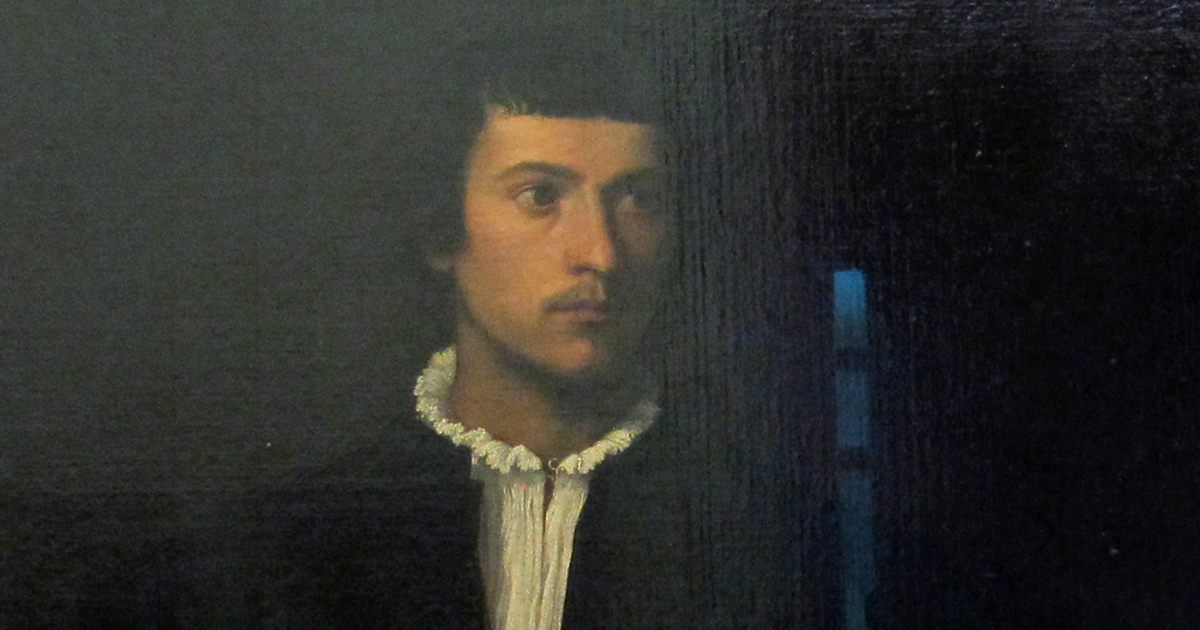
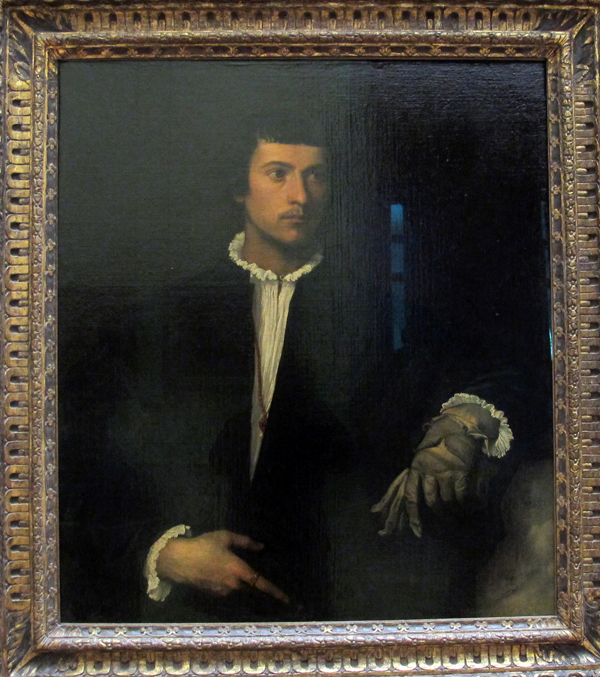
On the canvas is a masterfully rendered figure of a man shown three-quarter length, as if turning towards the viewer. The man sits or stands in a restrained pose, dressed in dark clothing with a white shirt, holding a second glove in his hand — an accessory that emphasises his refinement and the fashion of the time. His gaze is directed slightly to the side, as if in thought or observing something beyond the painting. The dark, plain background focuses attention on the figure and the expression of the face, creating an intimate, almost personal scene.
Style and technique
Titian uses rich colours, smooth tonal transitions, and a luxurious rendering of textiles — hallmarks of Venetian painting. His handling of light and shadow emphasises the volume of the face and clothing, and a small gesture — the glove in the hand — becomes a symbol of elegance and of Renaissance life. The artist refines the portrait genre so that not only likeness, but also the sitter’s psychology, gains importance.
Fate of the painting
This portrait came from the private collection of the Gonzaga family in Mantua. In 1627 it was acquired by King Charles I of England, and after his execution the painting entered the collection of the banker Eberhard Jabach. It was later purchased by King Louis XIV of France and became part of the royal art collection, which would later form the basis of the Louvre.
Personal view
Standing before this painting, you feel that Titian did not merely depict a person — he gave us a sunlit portrait of an era, where the sitter’s psychology matters more than background or decoration. The stillness of the gaze, the precision of detail, and the slight tension between reality and contemplation create the sense of a living presence, as if the figure is about to speak. And even when you move into the next room of the Louvre, his gaze — calm, confident, enigmatic — stays with you for a long time.


